How to Avoid SEO & AEO Penalties (and Protect your Brand) when using AI-Generated content on your Website
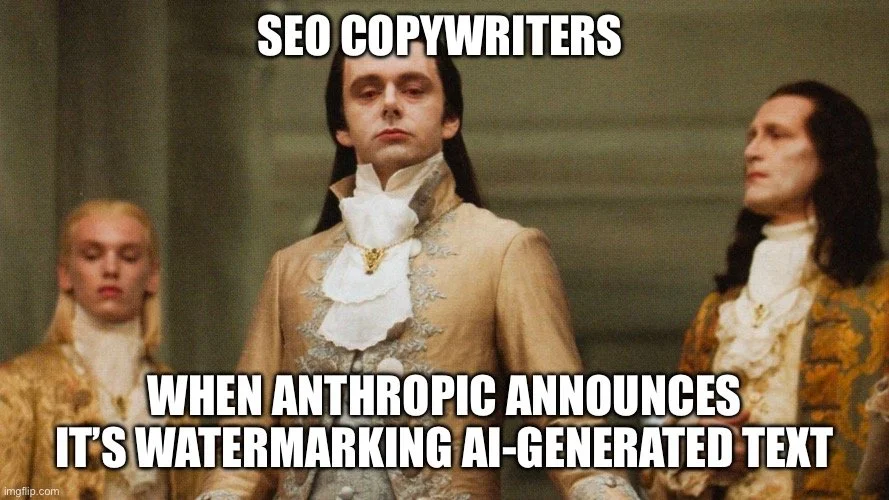
SEO copywriters everywhere are trying not to look too smug right now.
I just read that Anthropic announced plans to include embedded watermarks in all AI-generated text, and LinkedIn is all in a tizzy about the implications of this for AI-automated content creation.
First, a definition of what “watermarking” actually means.
AI watermarking is not new. Google has already used its SynthID to watermark AI-generated text since May of 2024.
But Anthropic announcing to the world that they’re embedding an imperceptible watermark into Claude-generated text is new in terms of public transparency. Read: it’s probably already been doing this since launch, but we’re just hearing about this now.
In fact, many AI assistants already use a range of hidden tactics that influence text output patterns, partly to improve safety and robustness, but most critically, to avoid AI model collapse. Model collapse happens when an AI is repeatedly trained on regurgitated AI-generated content. The AI’s output then becomes degraded. Think of a photocopy of a photocopy of a photocopy, with detail and image quality degrading with each pass. Yes, it turns out that AI models need human originality to thrive!
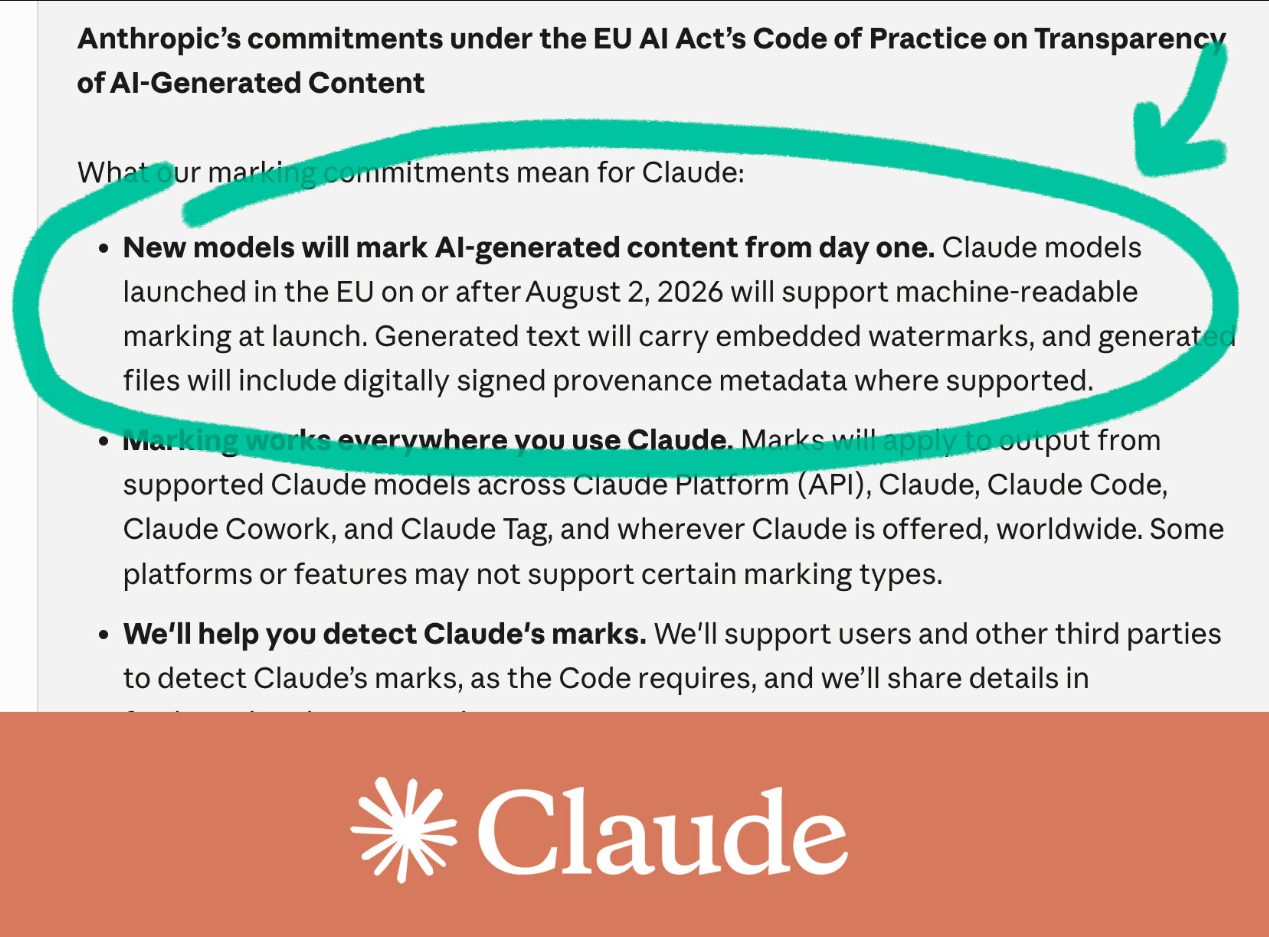
Today, Claude's inclusion of a watermark in and of itself isn’t going to cause an SEO / AEO penalty. Not yet anyway. But the wider conversation is a good reminder to strictly avoid raw copy-and-paste unedited AI-generated content directly into your website’s CMS (content management system).
(As an aside, imagine you are Google’s search and AI development team. Try to see the entire internet from their perspective. How do you protect your incredibly successful search business built on decades of brand loyalty, your own AI assistant Gemini, and immense profit against AI slop? Would you downgrade the visibility of poor-quality AI-generated content? Not yet, but that can all change in the flick of a switch of an algorithm update.)
But I digress… I’m writing this with my human #SEOcopywriter brain, so I’ll get to the point quickly and sketch out a better workflow that you can use to protect your website’s organic visibility.
To avoid your website’s performance being negatively impacted by copying & pasting AI-generated text directly into your website’s CMS, take the following steps:
Formalize a company-wide workflow to ensure that anyone with access to your website never, ever copies & pastes text directly from AI into the CMS! I’m serious. Not only does that bring along the dreaded watermark, but it also bits of invisible code that may prevent AI bots from parsing or ranking your content.
As a bare minimum, do a “Paste without formatting” or COMMAND + SHIFT + V on your Mac keyboard (CTRL + SHIFT + V on a PC). This prevents unwanted formatting or hidden code from being carried into your CMS. However, it does not necessarily remove a model-level watermark.
Even better, do a thorough human brain edit read-through of the copywriting. Yes, I’m asking you to use what your mama gave you. Print it out on paper and read it out loud. Ask yourself:
Is it engaging?
Do you think anyone will actually want to read it?
Does it have a strong narrative flow?
Does it have original human opinions backed by data?
Does it have a real human author who has a credible digital footprint tied to the topic?
It’s better to write one authentically well-written, human-authored article than push out 100x AI-slop blogs.
Why? Because human signals (scroll depth, clicks, engagement, conversion, etc.) are everything and, in a world of AI slop, you can be sure that Google is tracking these.
And these ‘human signals’ are not just for AEO and SEO (which are kind of both the same thing #IFYKYK) but for the actual human being on the other end who you are trying to convert into a customer. That’s the most important element in this whole equation.
I have been an SEO copywriter since 2006 and have seen search trends come and go. I have written hundreds, maybe thousands of SEO website pages (I’ve lost count), and tracked their performance. The thing that wins your organic marketing (and revenue generation) efforts is still well-written, on-page content with a strong strategic narrative.
Want to know more about how to protect your website’s visibility in the age of AI? Please contact us.
